
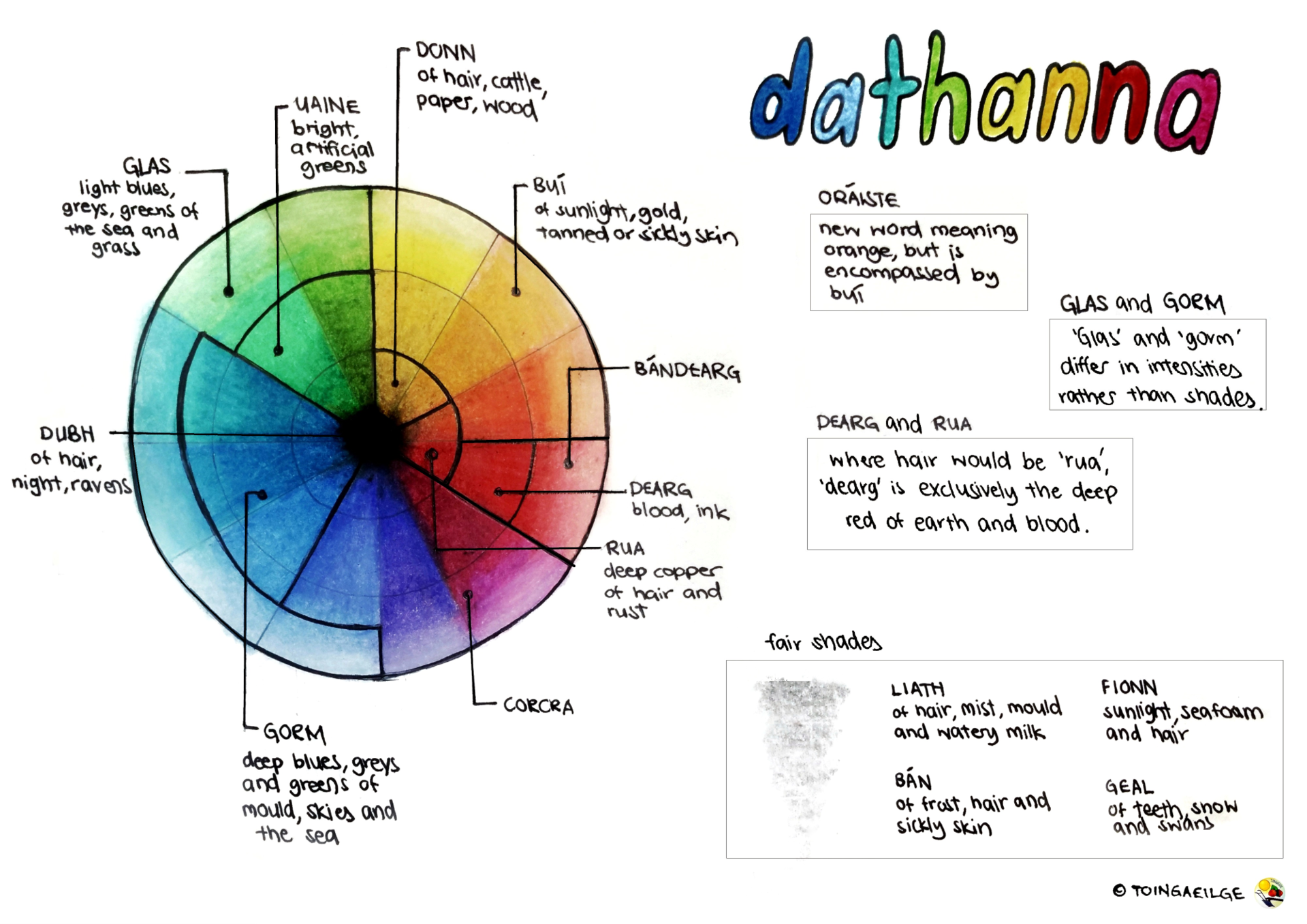
English has 11 basic colour terms – white, black, red, yellow, green, blue, orange, brown, pink, purple and grey. Of course, many thousands of words exist to describe colours beyond just these – cyan, rose, lavender, cerulean, maroon, and so on – but we still consider those to be “shades” of a basic “colour”. These basic colour terms seem obvious, inevitable even. How could we have a language without having a word for “red” or a word for “green”? But cross-linguistically, colour terms aren’t so simple. Different languages delineate different boundaries between basic colour terms on the infinite spectrum that exist, and this has had measurable impacts on categorisation and memory… or has it?
This question sits at the centre of a key debate in linguistics and cognitive science – that is, are categories in languages formed based on a shared human experience, leading to similarities and patterns between how languages define colour terms, or is it that categories in languages influence the perception, memory, and decision-making of those that speak them?
Firstly, what exactly do we define as a “basic colour term”? The most used definition is one by Brent Berlin and Paul Kay, from their book “Basic Colour Terms: Their Universality and Evolution”. This definition outlines five criteria for a word to be considered a basic colour term: it has to be monolexemic, consisting only of one basic form of a word, therefore not something like “yellow-red” or “blue-green”; it has to be monomorphemic, consisting only of one unit of meaning, therefore not something like “bluish”, which consists of the morphemes “blue” and “-ish”; it should not come under any other term of colour in its definition, like maroon being counted as a shade of red; it should be able to be used for any object, unlike for example “blonde” which primarily refers to hair; it should be easily understood by everyone, therefore restricting highly specific descriptions of colours like “the colour of grandma’s freezer”.
Berlin and Kay go on to use this definition to argue that there are cross-linguistic regularities in the way that languages develop colour categories – they split it into seven stages, where each new stage carves out another part of the spectrum, and goes as follows:
- Stage I – dark-cool and light-warm
- Stage II – red
- Stage III – either green or yellow
- Stage IV – both green and yellow
- Stage V – blue
- Stage VI – brown
- Stage VII – purple, pink, orange, or grey
This lays out the foundation of the Universalist argument, which states that there are patterns in how languages categorise colours because we all perceive colours in the same way.
With the definition of basic colour term in mind, we can begin to examine how colour terms can differ across languages. Consider Russian – it has the words “синий” (sínij) and “голубой” (golubój), which both map onto the English word “blue”. “Синий” refers to a darker blue, while “голубой” refers to a lighter blue. At first glance this might seem like an arbitrary distinction – why would a language come up with two separate terms for light and dark blue? Well, English does in fact do something similar for the words “red” and “pink” – isn’t pink just a lighter red? Despite this, we consider both colours to be separate, with a separate “feel” and boundary for each.
What makes this difference interesting is that research has consistently shown that Russian speakers are more quickly and more accurately able to identify the difference between shades of “синий” and “голубой” than English speakers. In one study, researchers presented participants with three squares of colour arranged in a triangle, with two being the same shade and one being different, and asked participants to point out the square that had the same shade as the one at the top of the triangle. When they tested English speakers against Russian speakers with shades that crossed the boundary between “синий” and “голубой”, they found that Russian speakers consistently had shorter reaction times by around 150 milliseconds.
This evidence helps set up the argument for linguistic relativity, a theory that states that language has the capability to influence the way that we perceive the world – instead of a universal human experience, colours are categorised by social reinforcement and a cultural understanding, and by categorising the colours in the way they do, Russian speakers are able to physically perceive their difference easier, as their brain moulds their perception around their language.
However, what’s interesting is that this advantage wasn’t always present – it disappeared when participants were given a verbal disruption, where participants silently rehearsed digit strings while performing the task. So, it’s not so easy to conclude that the participants were simply perceiving the colours completely separately. Instead, the study concluded that the difference in performance was likely due to the Russian speakers having more highly available and psychologically ingrained ‘labels’ to access when processing the colours, meaning that if they can say in their head that “this is синий” or “this is голубой”, they are capable of more easily distinguishing the difference between colours, and when they cannot (such as when their linguistic processes are occupied by having to recite numbers), they perceive the colours the same way as if they didn’t have a separate word for them.
This supports a variant of the linguistic relativity hypothesis called weak linguistic relativity. Rather than language changing the perception of the colours itself, it changes how speakers use labels to organise experience – helping them categorise, compare, and retain colour information. The difference is not in what they can perceive, but in how easily they can use language as a tool for fast decisions and memory, especially near boundaries between categories.
Zooming out from Russian and English, the way colour terms are assigned among the blue-green spectrum is one of the most variable cross-linguistically. It is common for the colours we consider “blue” and “green” to simply be represented as a single basic category – English linguists call this phenomenon “grue”. A historical example of this is the Chinese character “青” (“qīng” in Mandarin), which has been and still is used for both blue, green, and even grey colours at different times in history or in different contexts, for example, “青天” (“qīngtiān”) meaning “blue sky”, “青草” (“qīngcǎo”) meaning “green grass”, and “青絲” (“qīngsī”) meaning “black hair”. This is even the case in Japanese, where the same character “青” (pronounced “ao”) has been used in a very similar way, now primarily used to mean “blue” except for cases like “青林檎” (“ao ringo”) meaning “green apple”, or “青信号” (“aoshingō”) meaning “green traffic light” – in fact, this is the reason why in some parts of Japan, green traffic lights are actually closer to blue in colour.
Of course, not having a distinction between blue and green doesn’t mean that speakers can’t differentiate between them. English speakers can tell the difference between light and dark blue, and many other shades of colour when given to compare, and both Japanese and Chinese languages have unambiguous characters that mean “green”, such as “緑/綠”. The major differences that this categorisation leads to are differences in memory, recall, and the speed of processing new stimuli – fitting the arguments of weak linguistic relativity.
However, the phenomenon of “grue” can also show that there is still a pattern of categorisation across all languages – there are many languages that group together blue and green, but almost none that group together blue and red. Clearly, they don’t vary arbitrarily – the boundaries that are most common across languages seem caused by a shared, common perception. There still exist a limited number of broad categories of colours in languages, therefore, there still seems to be some level of constant experience from which humans categorise blue and green hues together, but not any random colours.
So, what can we conclude from this? As is often the case, it is likely a combination of both arguments. It is highly unlikely that languages directly impact the perception of colours in a literal sense, as all humans have the same biological eye cells that allow us to perceive colour, and so the categories in languages that develop are often systematic and frequent across languages. What is clear, however, is that once a society or language stabilises a distinction between colours, giving each colour across the boundary a basic colour term, this can act as a linguistic tool that allows for faster categorisation, distinction and recognition when determining colour. In short, colours are based on the biological perception we have of them, but the way we create the boundaries between different colours is influenced by social and cultural factors and can affect our ability to process and compare them.
Sources:
https://www.pnas.org/doi/pdf/10.1073/pnas.0701644104
https://www.pnas.org/doi/full/10.1073/pnas.0503281102
Berlin, Brent & Kay, Paul (1969). Basic Color Terms: Their Universality and Evolution. Berkeley: University of California Press.
https://www.pnas.org/doi/full/10.1073/pnas.0503281102
Image by Sherlyn – Own work, CC BY-SA 4.0, https://commons.wikimedia.org/w/index.php?curid=64246414

Leave a Reply